Quickstart
In five minutes you'll build a Zwaggen spec with one type, one endpoint, and a real request.
Heads up
A native desktop app, Zwaggen Desktop, is coming soon for CORS-free API testing. See Desktop for details. Until then, this guide uses Zwaggen Web.
You can follow along two ways:
- In the hosted playground — play.zwaggen.com, no install. Great for this walkthrough; JSONPlaceholder sends CORS-open headers so the request works without a proxy.
- Locally — if you haven't installed yet, see Installation.
The goal
We'll describe a tiny public API — GET /todos/1 from JSONPlaceholder — with a typed Todo response, run it, and see runtime validation in action.
1. Open the app
npx @zwaggen/webThis starts a local server at http://127.0.0.1:4173 and opens your browser. You'll see an empty spec with "My API" as the default title.
The CORS-bypass proxy is bundled in — flipping the "Use proxy" toggle on any endpoint routes the request through the same Node process at /proxy. No second terminal, no second port. To run the SPA without the bundled proxy, pass --no-proxy. (Standalone npx @zwaggen/proxy is still available for users running the proxy on a different machine.)
2. Set the base URL
- On the right sidebar (API Info), set Base URL to
https://jsonplaceholder.typicode.com.
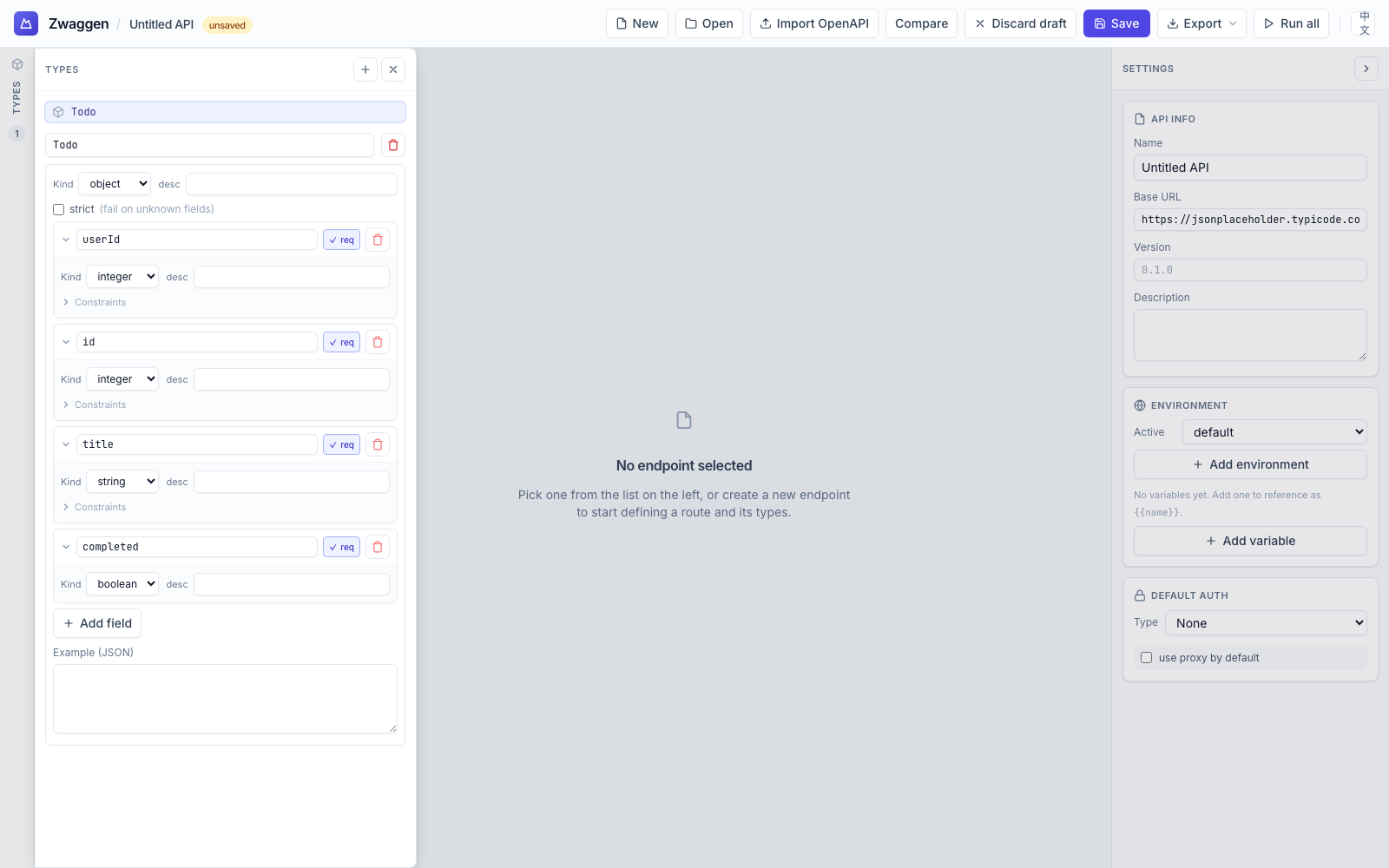
3. Create a Todo type
- In the left rail, select Types.
- Click + Add type. Name it
Todo. - Kind: object. Click + Add field four times and fill in:
| Name | Type | Required |
|---|---|---|
userId | integer | ✅ |
id | integer | ✅ |
title | string | ✅ |
completed | boolean | ✅ |
4. Create the endpoint
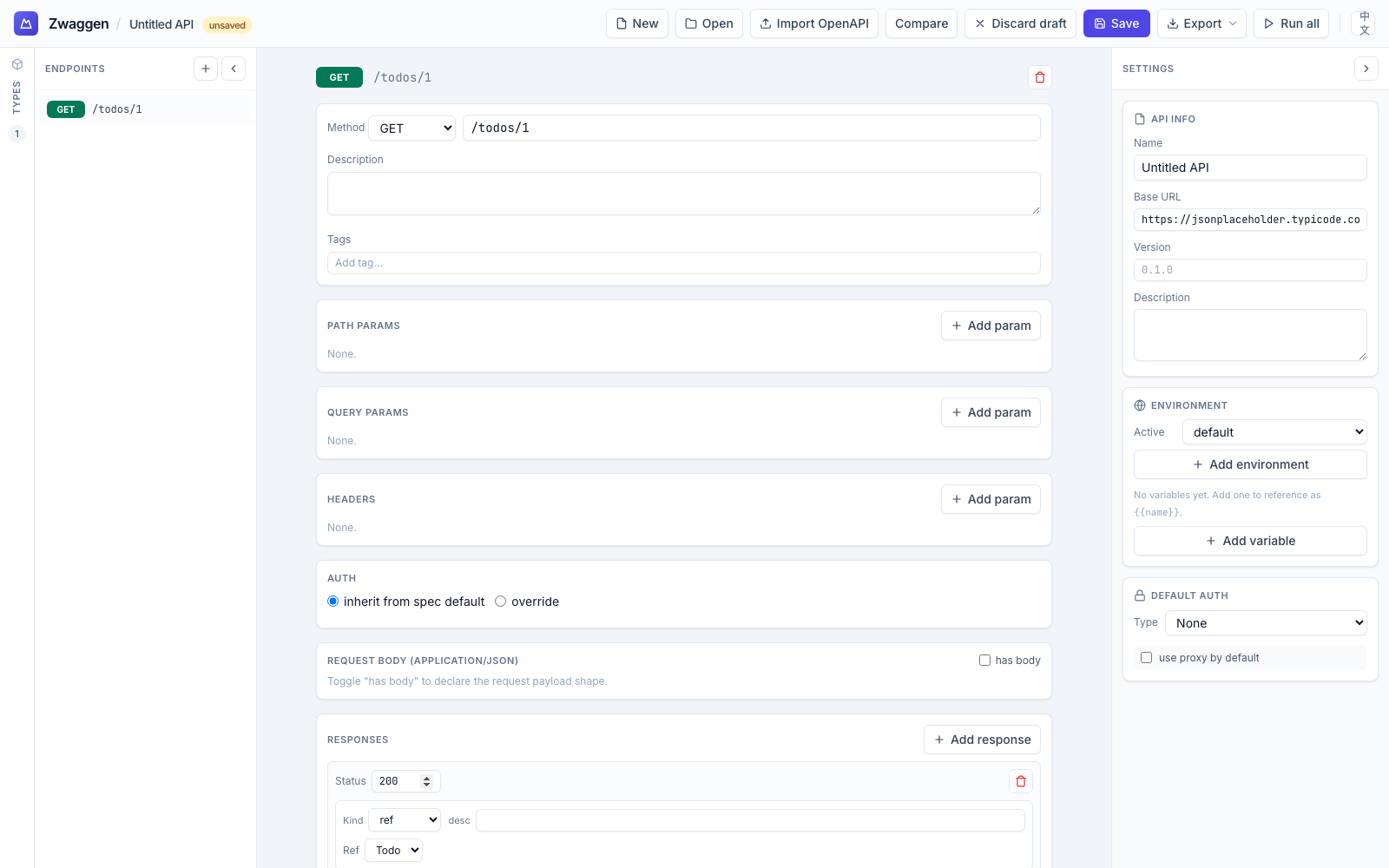
- In the left rail, select Endpoints.
- Click + Add endpoint.
- Method:
GET, Path:/todos/1, Name:Get todo by id. - Expand Responses → 200 → Type. Pick Ref and choose
Todo.
5. Run it
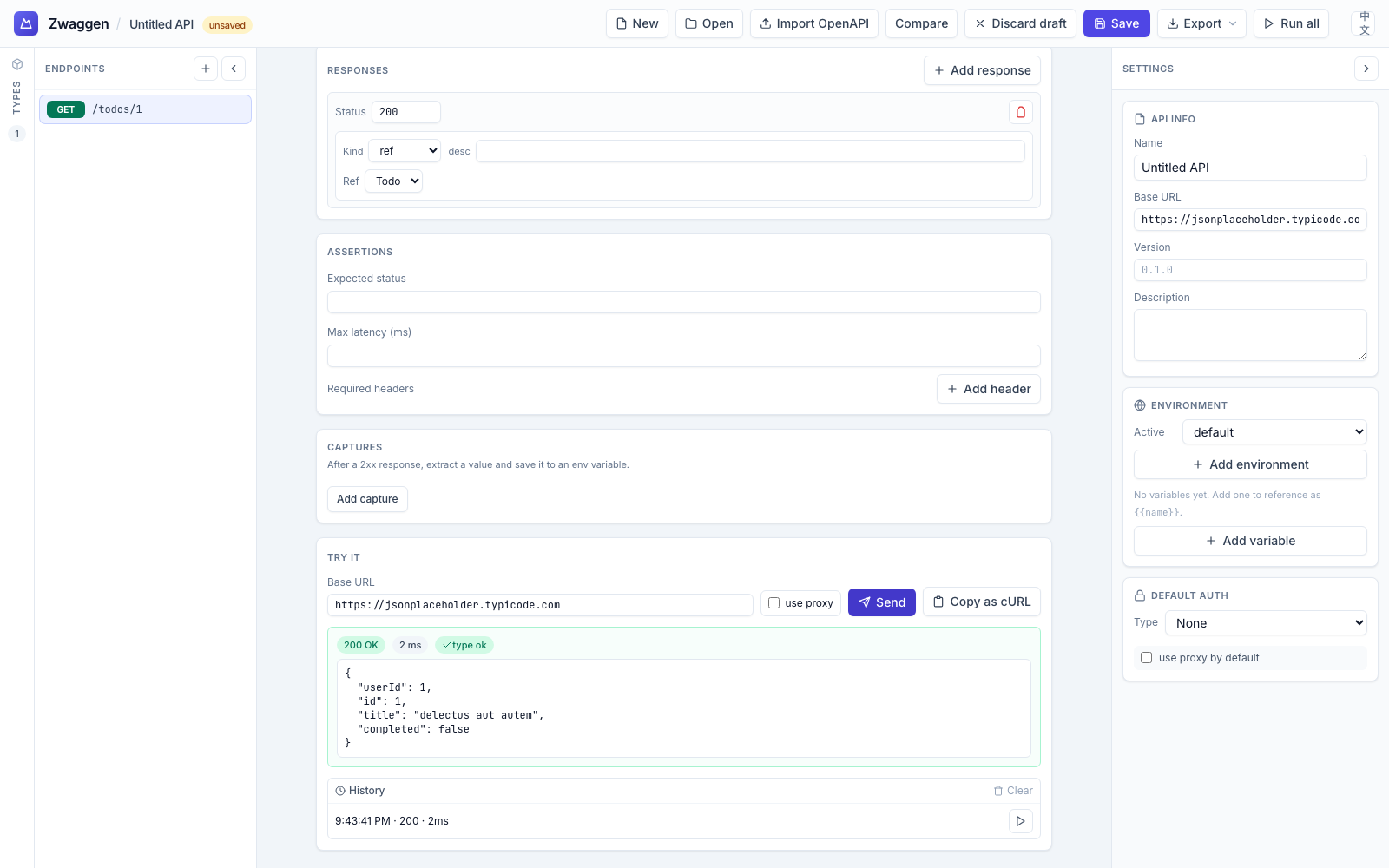
- Click the endpoint in the list. The Run panel opens on the right.
- Click Send.
- In the Response tab you should see the JSON body and, above it, a green type ok chip — the real response matched your
Todotype.
6. See validation find drift (optional)
- Go back to the
Todotype and change thetitlefield's Required to ✅ → already ✅. Instead, changetitle's kind tointeger. - Re-run the endpoint. The badge now reads Invalid, and the Response tab highlights the field that mismatched. This is what Zwaggen catches that Postman doesn't.
Revert title to string before moving on.
Next steps
- Core Concepts — the full mental model (Spec, Environments, Types, Endpoints).
- Type Builder — primitives, unions, arrays, references, examples.
- Assertions & Chaining — status/body assertions, reusing values from one response in the next request.
- Codegen — generate TypeScript types + Zod schemas + a typed client from your spec, so your frontend and backend converge on one contract.